

Who we are
HOW TRANSAFRICA WAS BORN
In the early 1970s, when I graduated, the classic destination for our generation—let’s say post-hippie—was India.
Before graduating, I had asked for a ticket to India, but just before leaving I had an accident: I wrecked the side of my mother’s car, and the money for the ticket ended up at the body shop instead.
The other popular destination for my generation was Morocco—a closer place, where I could travel even with the very little money I had left, hitchhiking.
During that trip to Morocco, I discovered the South, the Sahara—the northernmost part of the largest desert in the world. It fascinated me, intrigued me, motivated me, and I began organizing myself to cross the desert from north to south, eventually reaching sub-Saharan Africa, discovering its mysterious traditions, sacred masks, forests, and initiation places.
Sub-Saharan Africa, beyond the Sahara, became my passion.
To continue traveling there, I created what became the first exhibitions—Italy’s first exhibition of ethnic art—and I even started adventurous trades involving old trucks crossing the Sahara.
One day, some friends asked me, since I knew Burkina Faso, to organize a trip for them to Upper Volta, as it was called at the time. I did, and the trip was a success.
Without really planning it, I found myself becoming a travel organizer—partly by chance, partly by destiny.
This role of creating journeys in West Africa became my profession, and the Sahara my lifelong passion. What began as a passion became a profession that I still practice today with great pleasure.
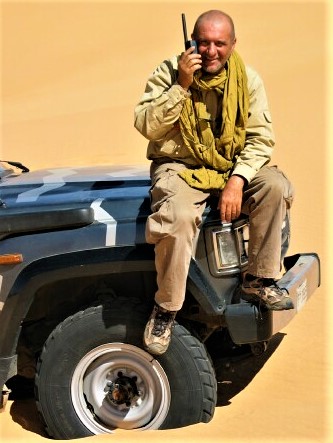
Photo of Alberto in Ghana, 1995
Africa in a Crocodile
Why the Crocodile is Transafrica’s Symbol?
The crocodile is Transafrica’s symbol because it represents the deepest and most ancient roots of African cultures.
In the savannas and forests of West Africa, for many ethnic groups, the crocodile is a sacred animal, carrying a powerful and dual meaning: fierce to those who do not understand it or to enemies, yet protective, a symbol of wealth, fertility, and abundance for those who are initiated into its knowledge.
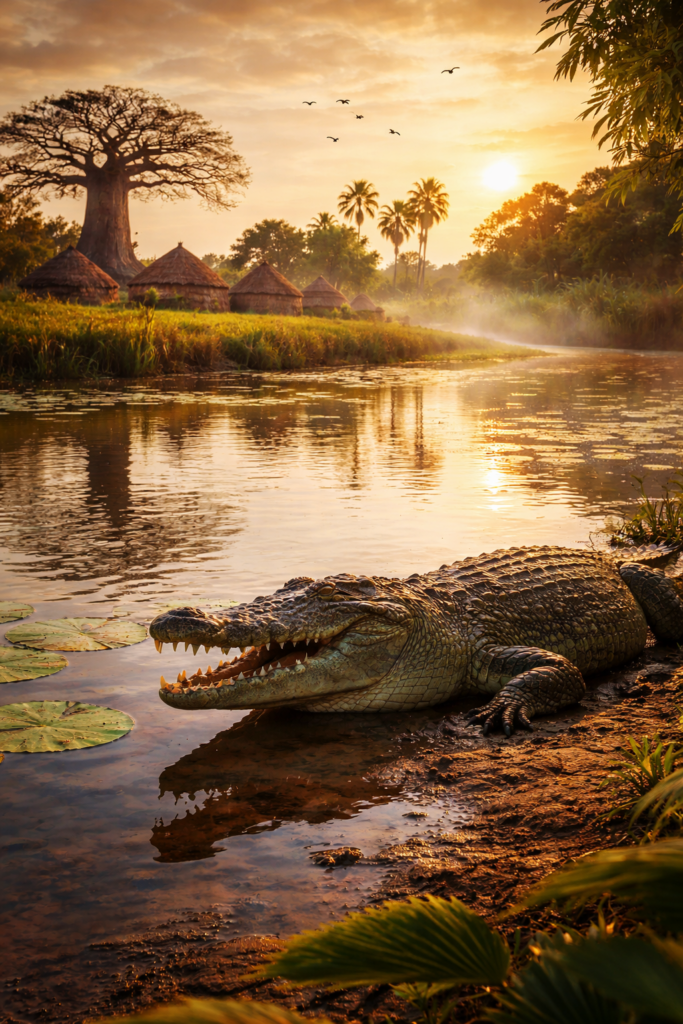
The crocodile is deeply connected to water, a central element in the African worldview. In flooded forests or savannas, still water becomes a mirror reflecting the sky—a symbolic threshold between the material and the spiritual world.
In this passage, the crocodile is considered the lord of the waters, the guardian of the boundary between worlds.
Water is life. The rains define agricultural cycles and, after the long dry season, bring rebirth: they turn the savannas green again, nourish the fields, and make harvests possible.
For this reason, in West African traditions, water represents the return to life, and the crocodile is both its guardian and its symbol.
This deep meaning lies at the core of Transafrica’s identity: a journey rooted in respect for African traditions, in the knowledge of their symbols, and in the awareness that Africa is not just a destination, but a world to be understood.
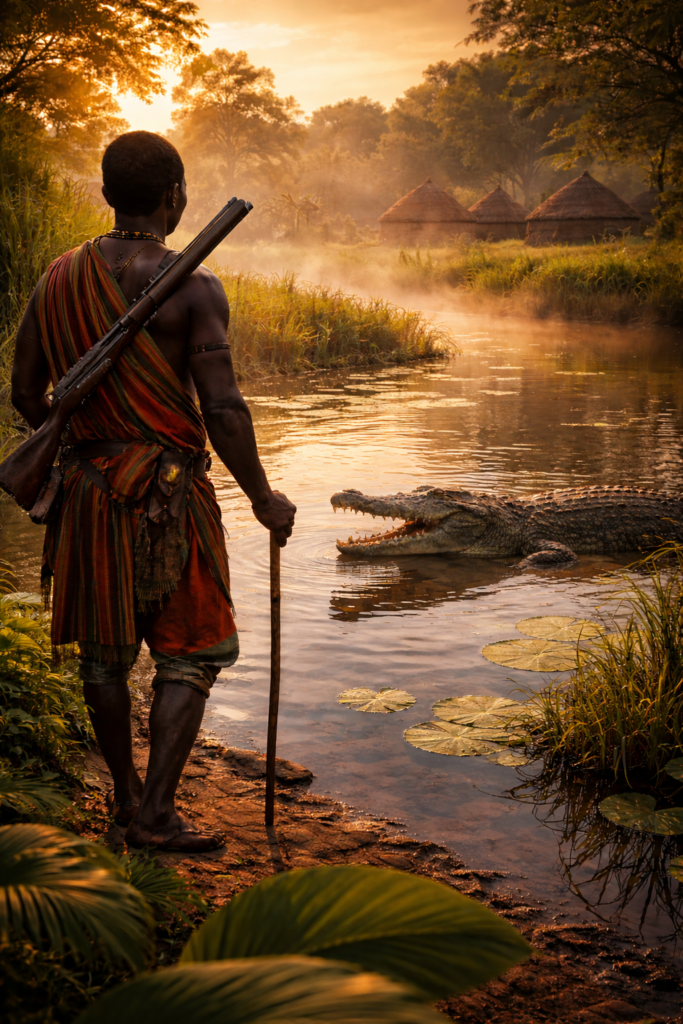
The Alliance Between Man and the Crocodile
My first encounter with a crocodile took place many years ago in the savannas of northern Burkina Faso, near the border with Mali.
I was in a village searching for ancient rock engravings when I noticed a crocodile lying still in a small lake at the center of the settlement, formed over time from clay extraction used to build houses.
Shortly after, a Fulani shepherd arrived with his herd. Goats and sheep approached the water without any fear; one goat came extremely close to the crocodile, yet nothing happened—no aggression, no fear.
I was told that the founder of the village had been a hunter, a figure of great spiritual power in African cultures.
According to tradition, this hunter, lost in the savanna and dying of thirst, was saved by a crocodile that guided him to water.
From that moment on, a sacred alliance was born: the crocodile became the protector of the village and its people, and in return it was honored as a sacred animal.
Since then, crocodiles have lived alongside the inhabitants, never attacking livestock or humans, and have become a symbol of protection, balance, and mutual respect.
The Villages of Sacred Crocodiles
In several villages across West Africa, the crocodile is still considered a form of spiritual protection.
I have seen women collecting water just a few meters from crocodiles, children moving freely, and domestic animals approaching the water’s edge—without any incidents, for centuries.
In these places, the real danger is not the crocodiles, but those who might threaten the village’s balance.
The crocodile is seen as its guardian: during ancient tribal wars, its presence was interpreted as a sign of imminent danger.
This belief dates back to very ancient times. In ancient Egypt, the god Sobek, depicted with a crocodile head, was associated with the waters of the Nile and the fertility of the land.
Even today, crocodile worship is still alive in the flooded forests of Ghana’s western coast, where traditional rituals testify to a millennia-old relationship between humans, water, and this sacred animal.
For Transafrica, the crocodile represents all of this: protection, knowledge, continuity, and respect for African traditions.
It is the symbol of a journey that does not simply cross territories, but builds a deep connection with the cultures that inhabit them.